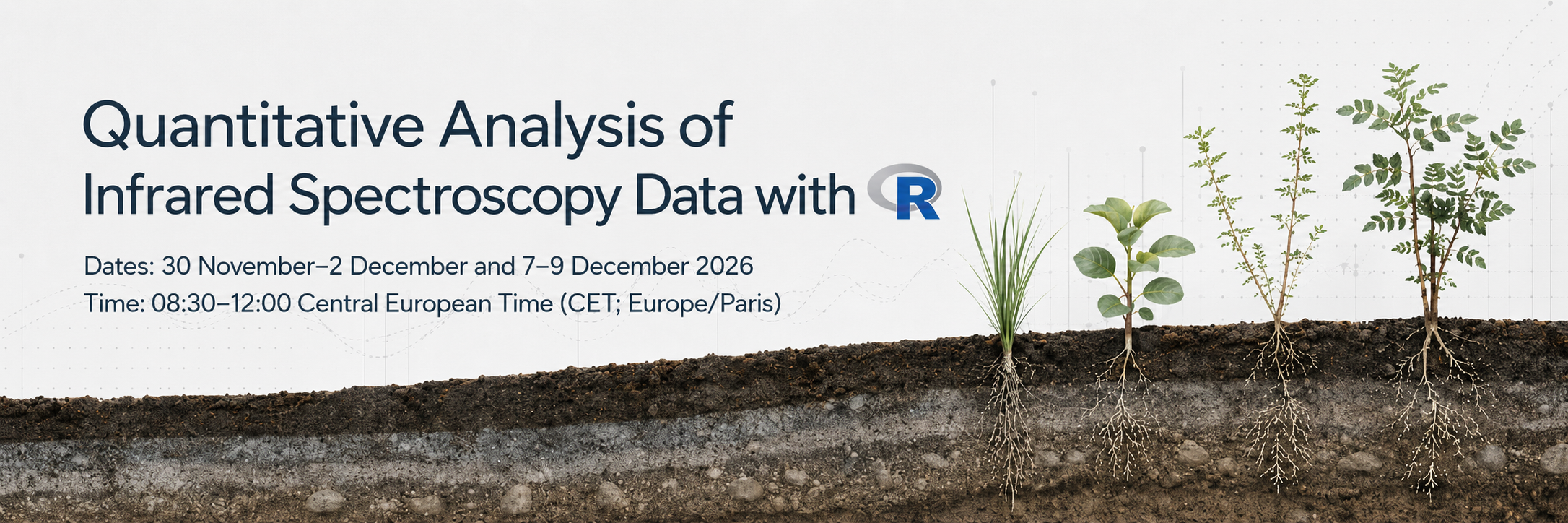
A live online short course for soil, plant, environmental, and agricultural scientists.
Learn how to analyse visible, near-infrared, and mid-infrared spectroscopy data using R, from spectral pre-processing and exploratory analysis to calibration modelling and validation.
Format: Live online course with recordings available afterwards
Duration: 6 live sessions of 3.5 hours each, approximately 21 hours in total
Dates: 30 November–2 December and 7–9 December 2026
Time: 08:30–12:00 Central European Time (CET; Europe/Paris)
Language: English
Course fee: €415, including live sessions, recordings, R scripts, and datasets
Course at a glance
Lectures, demonstrations, and guided computer practicals delivered by video link.
Participants receive R scripts, datasets, and installation guidance before the course.
All sessions are recorded and made available to registered participants.
About the course
This six-session short course, equivalent to approximately three full days of teaching, introduces the quantitative analysis of infrared spectroscopy data using the R programming language. Infrared spectroscopy is a rapid, non-destructive, and cost-effective sensing technique with extensive applications in soil, plant, agricultural, and environmental sciences.
The course combines lectures with practical exercises and interactive demonstrations. Participants will work with real spectral data and will have opportunities to ask questions throughout the sessions.
The programme covers:
- the principles of visible, near-infrared, and mid-infrared spectroscopy;
- interpretation of spectral wavelengths and molecular vibrations;
- handling and pre-processing raw spectral data;
- exploratory spectral analysis using principal component analysis;
- detection of outlier spectra;
- selection of samples for laboratory analysis;
- multivariate calibration modelling, including conventional statistical and machine-learning approaches;
- validation and interpretation of model predictions.
By the end of the course, participants should be able to:
- select appropriate pre-processing methods for their spectral data;
- explore infrared spectral datasets and identify common analytical issues;
- identify outlier spectra using appropriate statistical methods;
- design a sampling strategy for selecting samples for laboratory analysis;
- develop and validate multivariate prediction models using infrared spectroscopy data;
- interpret and communicate the performance of spectral calibration models.
About the instructor
Dr Alexandre Wadoux is a Lecturer in Soil Science at James Cook University, Australia. His research spans infrared soil spectroscopy, chemometrics, digital soil mapping, and statistical learning, with a particular focus on model validation and uncertainty. He holds a PhD in applied geostatistics from Wageningen University and previously worked at INRAE as a Marie Skłodowska-Curie Fellow and at the University of Sydney. In this course, he guides participants through practical R workflows for analysing spectra and developing and evaluating prediction models.
Read more about Alexandre’s background.
What previous participants say
“The course gave me a much clearer understanding of soil spectral analysis in R, with practical scripts and examples I could adapt to my own research.”
— Participant, SPEC03
“A useful combination of theory and practical analysis, with clear explanations of preprocessing, calibration, validation, and how to interpret model results.”
— PhD student, SPEC04
Course format
Live online delivery
The instructor will deliver lectures and guide participants through computer practicals via video link. A reliable internet connection is essential.
Recordings
All sessions will be recorded and made available to participants. This allows attendees from different time zones to follow the course even where live attendance is difficult.
Teaching approach
The course combines taught theory, practical examples, and guided R-based analyses. All R scripts used during the sessions will be shared with participants and explained step by step.
Who should attend?
This course is suitable for researchers and professionals who wish to analyse visible, near-infrared, or mid-infrared spectral data in R.
It is particularly relevant for:
- graduate students, doctoral candidates, postdoctoral researchers, and academic staff;
- soil, plant, environmental, ecological, and agricultural scientists;
- analysts working with infrared spectroscopy data in research, consulting, or laboratory settings;
- participants seeking practical experience in spectral data analysis and chemometrics.
Prerequisites
Quantitative background
Basic familiarity with infrared sensing and elementary statistical concepts, such as linear regression, is helpful.
Computing background
Previous experience with R or RStudio is useful but not essential. Guidance will be provided throughout the practical sessions.
Equipment and software
Participants should have access to:
- a laptop or desktop computer;
- a stable internet connection;
- a working installation of R and RStudio;
- the ability to install the required R packages before the course.
R and RStudio are free, open-source software available for Windows, macOS, and Linux. A complete list of required packages, scripts, and datasets will be provided before the course.
A webcam is not required but is encouraged to support interaction during live sessions. A large monitor, or a second screen, may also improve the practical learning experience.
Course programme
Days 1 and 2 (7 hours) — Introduction and spectral pre-processing
08:30–12:00 CET (Europe/Paris)
- Introduction to spectral inference in soil and plant sciences
- Handling spectral data in R
- Pre-processing raw spectra
- Practical exercises in data handling and pre-processing
- Exploratory spectral analysis
- Practical exercises in exploratory analysis
Days 3 and 4 (7 hours) — Similarity, outliers, and sample selection
08:30–12:00 CET (Europe/Paris)
- Spectral similarity analysis
- Detection of outlier spectra
- Practical exercises in outlier detection
- Selecting samples for laboratory analysis
- Practical exercises in sample selection
Days 5 and 6 (7 hours) — Calibration modelling and validation
08:30–12:00 CET (Europe/Paris)
- Estimating properties from spectra
- Introduction to multivariate statistical models
- Practical exercises in calibration modelling
- Validation and interpretation of predictions
- Practical exercises in model validation
- Bring-your-own-data session or a large integrated case study
- Discussion and questions
Registration
Course fee
€415
Includes all six live sessions (approximately 21 hours), session recordings, R scripts, datasets, and software installation guidance.
The course is limited to 20 participants. Registration is confirmed once payment has been received.
Register and pay online, or request an invoice if your university, laboratory, or employer will pay the course fee.
Register and pay — €415 Request an institutional invoiceThe invoice button opens a pre-filled email to alexandre.wadoux@yahoo.fr. Please include the participant details, institution billing name and address, and any required purchase order reference. If your email application does not open, send these details directly to the address above.
Cancellation policy
Cancellations made up to 28 days before the course start date are eligible for a refund, less a 25% cancellation fee.
Cancellations made less than 28 days before the course may be considered on a case-by-case basis. Please contact the instructor as soon as possible.
Failure to attend the course without prior cancellation will result in the full course fee being retained.
Should the course be cancelled because of unforeseen circumstances, participants will receive a full refund of the course fee.
Contact
For questions about course suitability, registration, payment, or accommodation for different time zones, contact: